

-
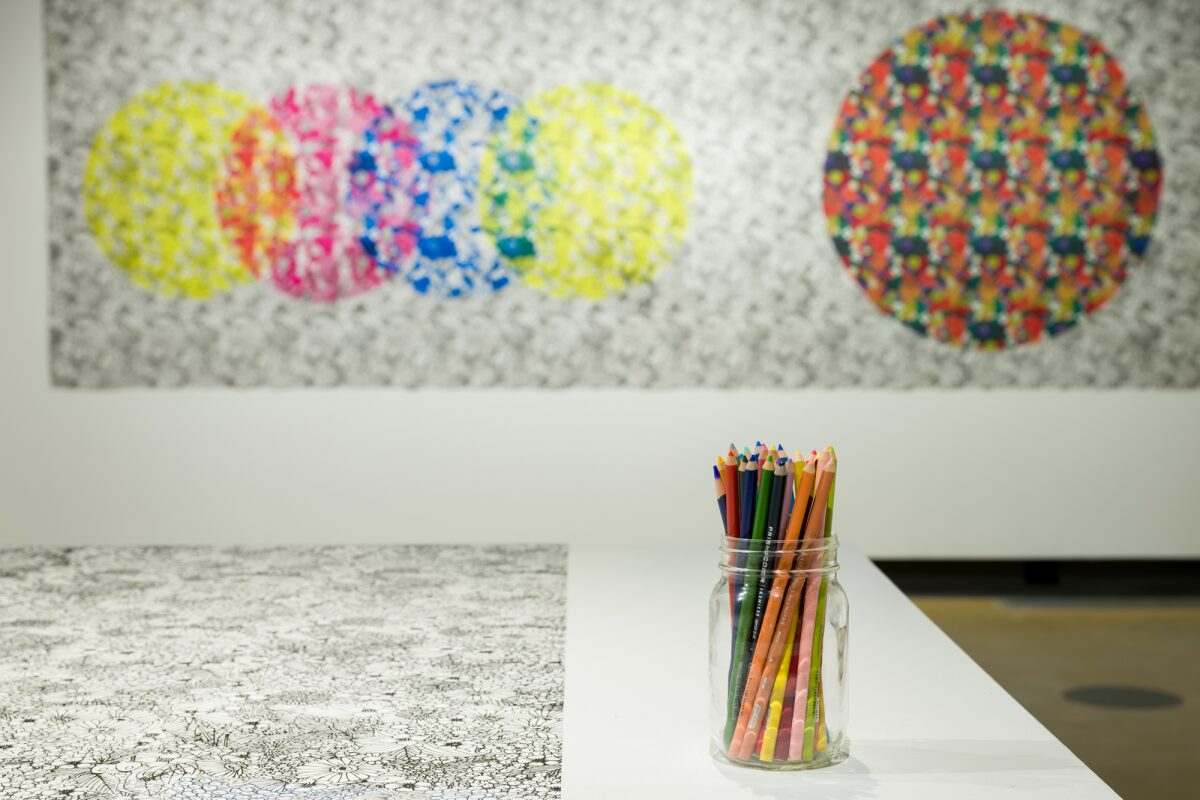
S’entourer d’herbes médicinales (Vue de l'installation)
fr S’entourer d’herbes médicinales est un corpus d’œuvres sérigraphiées qui explore l’imagerie des plantes médicinales qui abondent dans les paysages maritimes. Le choix des plantes qui composent ce motif botanique est inspiré de l’herbier de M’ame B, personnage du livre The Birth House, de l’autrice Ami McKay. Le motif créé par l’artiste orne d’ailleurs la couverture de la traduction française du roman (Prise de parole, 2023), signée par Sonya Malaborza. On y retrouve la camomille, le sorbier, le pissenlit, la lavande, la tanaisie, le plantain, le framboisier, le lin, l’ortie, le souci, la bourse-à-pasteur, le quatre-temps, le houblon et la baie d’églantier (cette dernière communément surnommée le « gratte-tchu » en Acadie). Avec cette série réalisée à l’Atelier d’estampe Imago lors d’une résidence de création, l’artiste voulait surmonter le défi d’imprimer en grand format. Pour rendre visibles les composantes du processus d’impression quatre couleurs (CMYK), elle en isole chacune des couleurs (cyan, magenta, jaune et noir) sur un motif répétable qu’elle a elle-même conçu. Lorsque superposées, ces teintes donnent une gamme complète de couleurs, comme en témoignent les œuvres exposées. en S’entourer d’herbes médicinales is a collection of screen prints exploring the imagery of medicinal plants that abound in maritime landscapes. The plants that make up the botanical motif are inspired by Mrs. B’s herbarium, as depicted in Ami McKay’s novel The Birth House. In fact, the motif appears on the cover of L’accoucheuse de Scots Bay, the French translation of the novel by Sonya Malaborza (Prise de parole, 2023). The prints feature chamomile, rowan, dandelion, lavender, tansy, plantain, raspberry leaf, flax, nettle, calendula, shepherd’s purse, bunchberry, hops, and rosehip (the latter colloquially called “gratte-tchu” (butt-scratcher) in Acadie). Created at Imago Artist-Run Print Studio as part of a creative residency, the series is the result of the artist attempting to overcome the challenge of printing in large format. To render the elements of the four-colour (CMYK) process visible, Carole Deveau isolated each colour (cyan, magenta, yellow, and black) on a replicable pattern that she designed herself. Superimposed, the hues create a full range of colours, as seen in adjacent works.
-
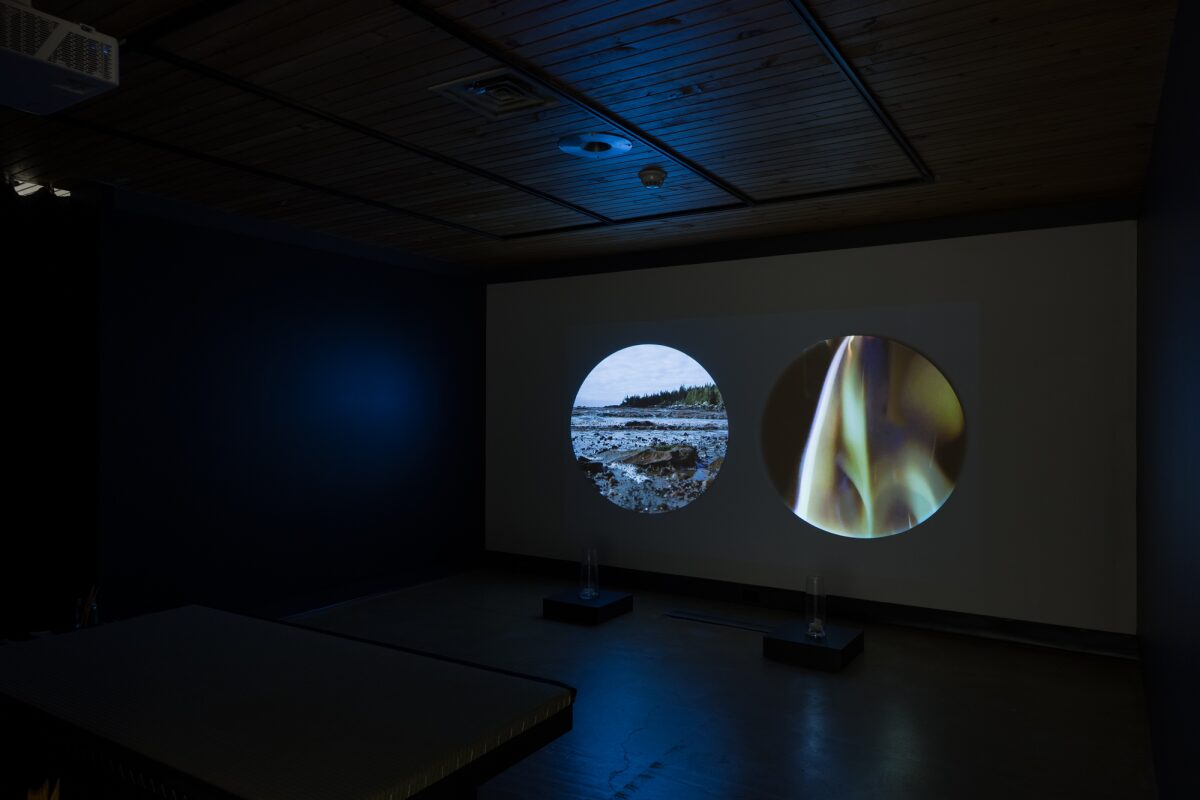
À la chaleur du feu ou à la douceur de l'eau ; à vous de décider, 2026
fr S’inscrivant dans un projet de longue durée autour du lâcher-prise, cette installation vidéo, inspirée d’une œuvre produite en 2020, invite le public à se recueillir pour ensuite inscrire sur un bout de papier un lâcher-prise à déposer dans l’eau ou dans le feu. en Part of a lengthy project around the act of letting go, this video installation, inspired by one created in 2020, encourages members of the public to meditate before writing an act of letting go on a piece of paper that will then go into water or fire.
-
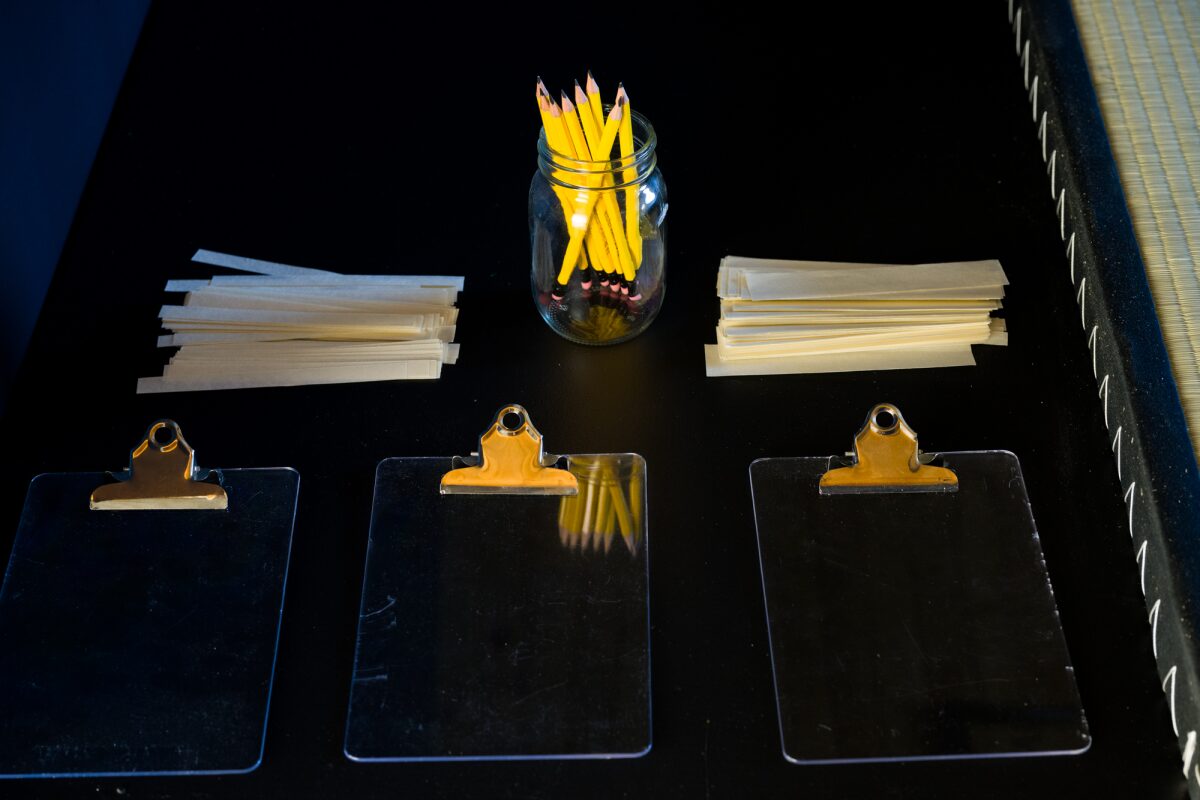
À la chaleur du feu ou à la douceur de l'eau ; à vous de décider, 2026
fr S’inscrivant dans un projet de longue durée autour du lâcher-prise, cette installation vidéo, inspirée d’une œuvre produite en 2020, invite le public à se recueillir pour ensuite inscrire sur un bout de papier un lâcher-prise à déposer dans l’eau ou dans le feu. en Part of a lengthy project around the act of letting go, this video installation, inspired by one created in 2020, encourages members of the public to meditate before writing an act of letting go on a piece of paper that will then go into water or fire.
-
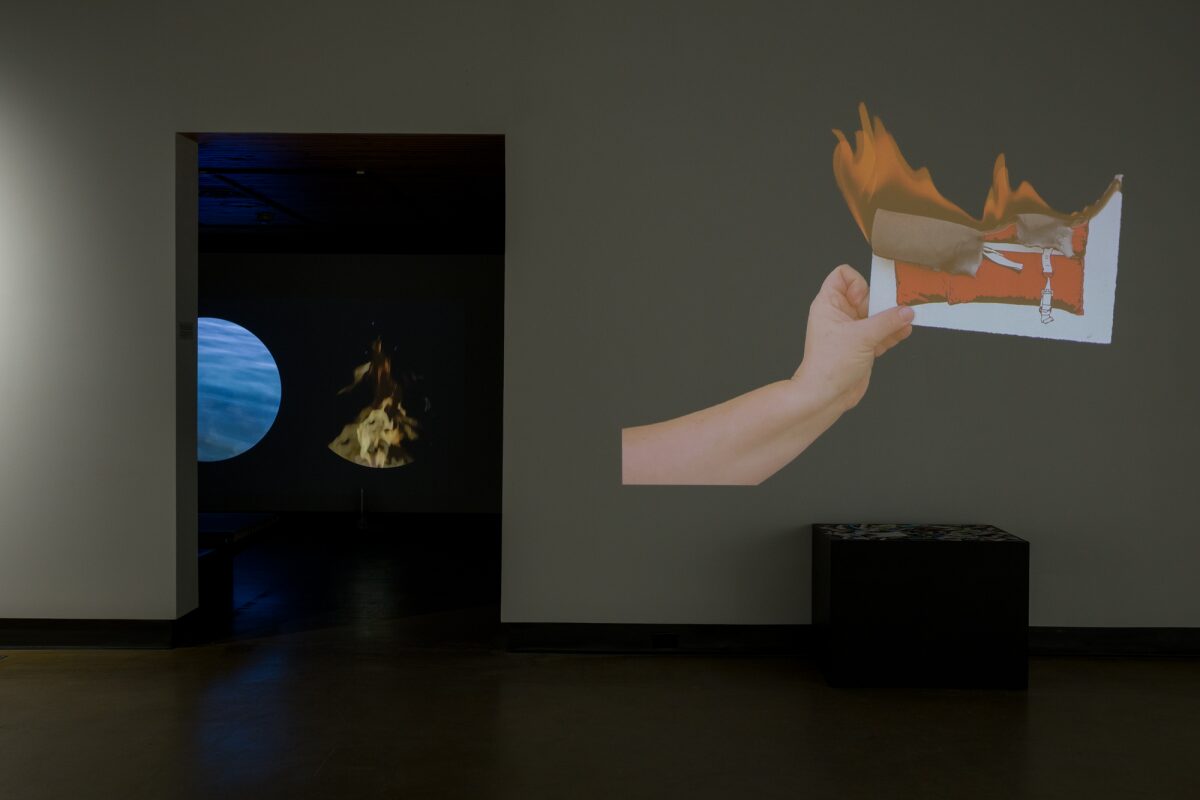
L’art de lâcher prise, 2024
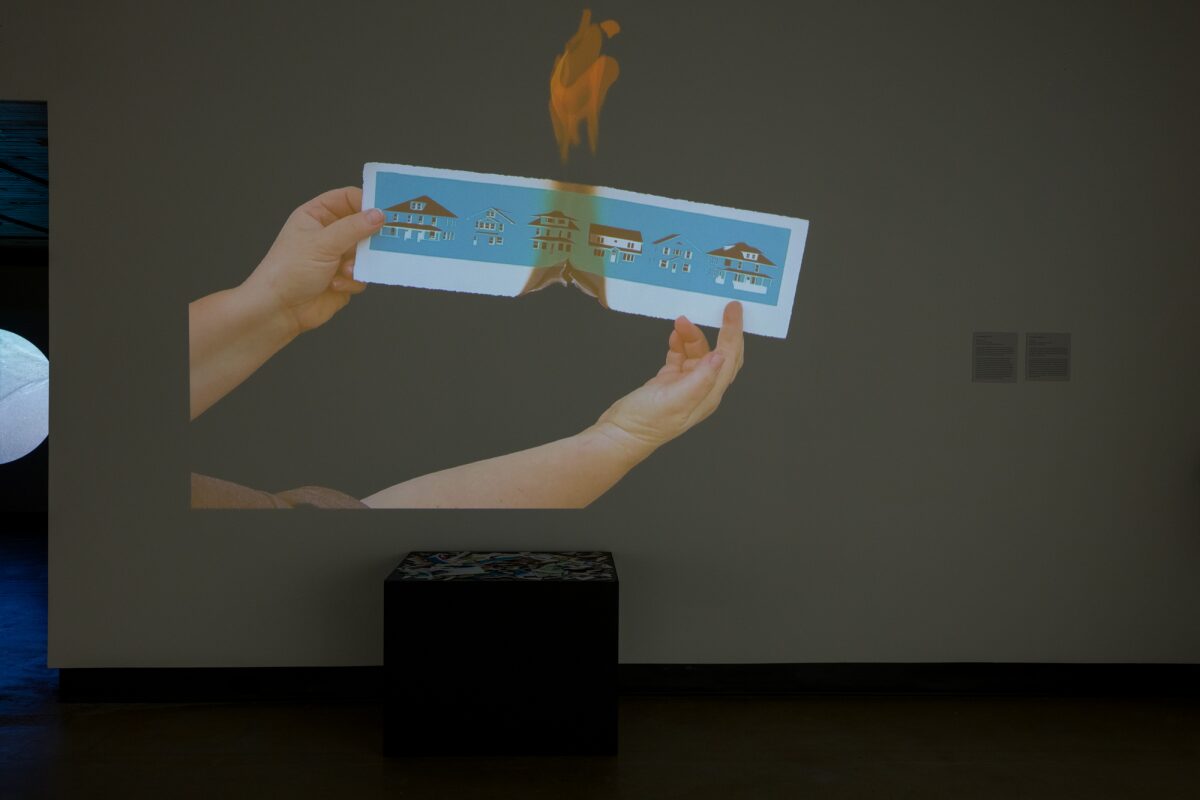
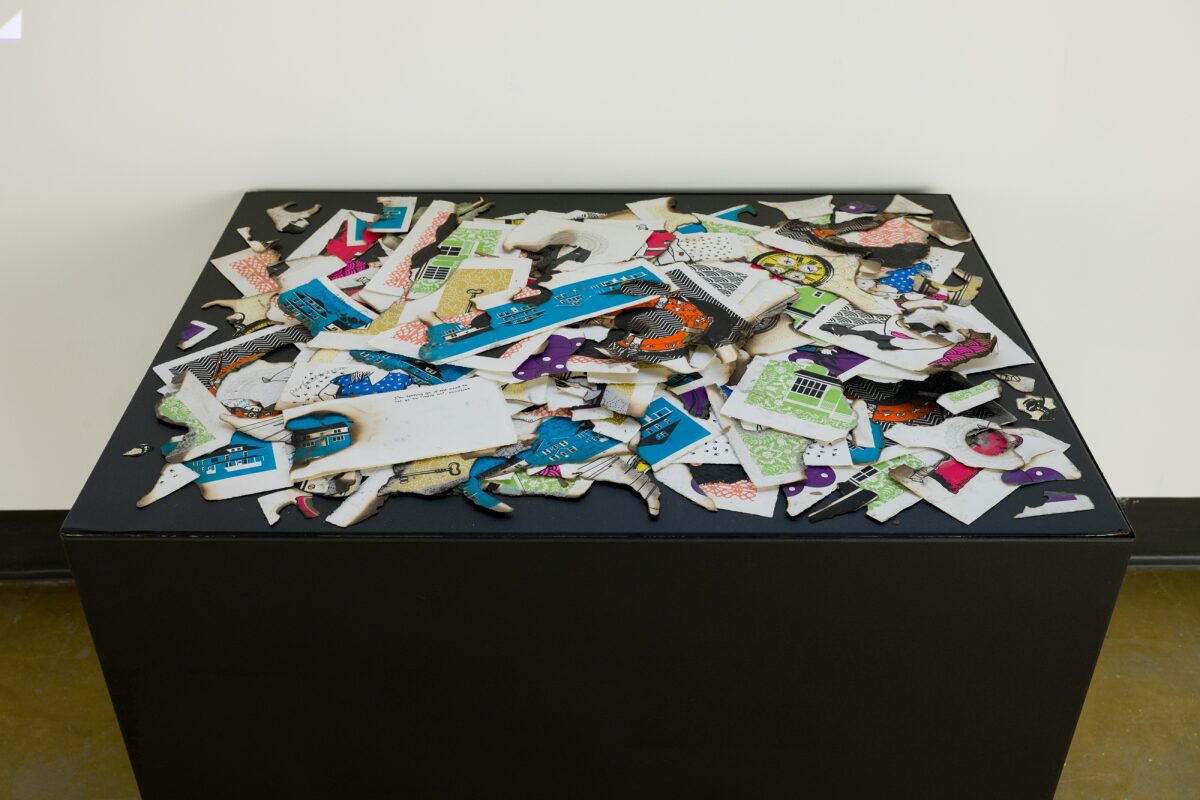
fr À l’écran, la main de l’artiste, contre un fond noir, tient une œuvre imprimée qu’elle enflamme et qu’elle laisse brûler. Carole Deveau détruit ainsi les douze dernières images sérigraphiées qu’elle a elle-même réalisées dans le cadre d’un projet participatif qui a fait l’objet d’une exposition à la Galerie d’art Françoise-Chamard-Cadieux au Centre culturel Aberdeen en 2024. L’art de lâcher prise gravite autour d’une série d’images qui a constitué la prémisse de nombreuses rencontres entre l’artiste et des gens de son entourage, ainsi que l’outil avec lequel chaque personne est arrivée à la découverte d’un lâcher-prise réalisable. Au fil des neuf ans au cours desquels s’est déroulé le projet, deux cent douze personnes se sont entretenues avec l’artiste autour des images de la série – dont une montre de poche, une maison, une longue robe blanche, une bouée de sauvetage, une serrure – pour discuter des émotions, des regrets et des souvenirs que celles-ci suscitaient en elles. Chaque personne était ensuite invitée à brûler l’image de leur choix en temps et lieu, en guise de rituel qui scelle et rend tangible l’acte de lâcher-prise. Les œuvres partiellement brûlées ont été remises à l’artiste, accompagnées de quelques mots qui résumaient l’intention du geste posé. en On the screen, the artist’s hand, against a black background, holds a printed work to which she sets fire and then lets burn. Carole Deveau thus destroys the final 12 screen printed images that she created as part of a participatory project that was the subject of an exhibition at the Galerie d’art Françoise-Chamard-Cadieux at the Aberdeen Cultural Centre in 2024. L’art de lâcher prise centres on a series of images that served as the basis of several meetings between the artist and people from her community, as well as the tool with which each participating person identified an achievable act of letting go. Over the course of nine years dedicated to this project, the artist interviewed 212 people to talk about the feelings, regrets, or memories evoked by the images in the series, which included a pocket watch, a house, a long white dress, a safety buoy, and a lock, among others. Each person was then invited to burn the image they had chosen, at a time and place of their choosing, as a ritual that sealed and made tangible the act of letting go. The partially burned works were then given back to the artist, accompanied by a few words summarizing the person’s intention behind the act.
-
L’art de lâcher prise, 2024
fr À l’écran, la main de l’artiste, contre un fond noir, tient une œuvre imprimée qu’elle enflamme et qu’elle laisse brûler. Carole Deveau détruit ainsi les douze dernières images sérigraphiées qu’elle a elle-même réalisées dans le cadre d’un projet participatif qui a fait l’objet d’une exposition à la Galerie d’art Françoise-Chamard-Cadieux au Centre culturel Aberdeen en 2024. L’art de lâcher prise gravite autour d’une série d’images qui a constitué la prémisse de nombreuses rencontres entre l’artiste et des gens de son entourage, ainsi que l’outil avec lequel chaque personne est arrivée à la découverte d’un lâcher-prise réalisable. Au fil des neuf ans au cours desquels s’est déroulé le projet, deux cent douze personnes se sont entretenues avec l’artiste autour des images de la série – dont une montre de poche, une maison, une longue robe blanche, une bouée de sauvetage, une serrure – pour discuter des émotions, des regrets et des souvenirs que celles-ci suscitaient en elles. Chaque personne était ensuite invitée à brûler l’image de leur choix en temps et lieu, en guise de rituel qui scelle et rend tangible l’acte de lâcher-prise. Les œuvres partiellement brûlées ont été remises à l’artiste, accompagnées de quelques mots qui résumaient l’intention du geste posé. en On the screen, the artist’s hand, against a black background, holds a printed work to which she sets fire and then lets burn. Carole Deveau thus destroys the final 12 screen printed images that she created as part of a participatory project that was the subject of an exhibition at the Galerie d’art Françoise-Chamard-Cadieux at the Aberdeen Cultural Centre in 2024. L’art de lâcher prise centres on a series of images that served as the basis of several meetings between the artist and people from her community, as well as the tool with which each participating person identified an achievable act of letting go. Over the course of nine years dedicated to this project, the artist interviewed 212 people to talk about the feelings, regrets, or memories evoked by the images in the series, which included a pocket watch, a house, a long white dress, a safety buoy, and a lock, among others. Each person was then invited to burn the image they had chosen, at a time and place of their choosing, as a ritual that sealed and made tangible the act of letting go. The partially burned works were then given back to the artist, accompanied by a few words summarizing the person’s intention behind the act.
-
L’art de lâcher prise, 2024
fr À l’écran, la main de l’artiste, contre un fond noir, tient une œuvre imprimée qu’elle enflamme et qu’elle laisse brûler. Carole Deveau détruit ainsi les douze dernières images sérigraphiées qu’elle a elle-même réalisées dans le cadre d’un projet participatif qui a fait l’objet d’une exposition à la Galerie d’art Françoise-Chamard-Cadieux au Centre culturel Aberdeen en 2024. L’art de lâcher prise gravite autour d’une série d’images qui a constitué la prémisse de nombreuses rencontres entre l’artiste et des gens de son entourage, ainsi que l’outil avec lequel chaque personne est arrivée à la découverte d’un lâcher-prise réalisable. Au fil des neuf ans au cours desquels s’est déroulé le projet, deux cent douze personnes se sont entretenues avec l’artiste autour des images de la série – dont une montre de poche, une maison, une longue robe blanche, une bouée de sauvetage, une serrure – pour discuter des émotions, des regrets et des souvenirs que celles-ci suscitaient en elles. Chaque personne était ensuite invitée à brûler l’image de leur choix en temps et lieu, en guise de rituel qui scelle et rend tangible l’acte de lâcher-prise. Les œuvres partiellement brûlées ont été remises à l’artiste, accompagnées de quelques mots qui résumaient l’intention du geste posé. en On the screen, the artist’s hand, against a black background, holds a printed work to which she sets fire and then lets burn. Carole Deveau thus destroys the final 12 screen printed images that she created as part of a participatory project that was the subject of an exhibition at the Galerie d’art Françoise-Chamard-Cadieux at the Aberdeen Cultural Centre in 2024. L’art de lâcher prise centres on a series of images that served as the basis of several meetings between the artist and people from her community, as well as the tool with which each participating person identified an achievable act of letting go. Over the course of nine years dedicated to this project, the artist interviewed 212 people to talk about the feelings, regrets, or memories evoked by the images in the series, which included a pocket watch, a house, a long white dress, a safety buoy, and a lock, among others. Each person was then invited to burn the image they had chosen, at a time and place of their choosing, as a ritual that sealed and made tangible the act of letting go. The partially burned works were then given back to the artist, accompanied by a few words summarizing the person’s intention behind the act.
Carole Deveau
Titre de l'exposition: Se (re)cueillir | To make whole
Description de l'exposition: fr
Se (re)cueillir | To make whole est un herbier du soin, une onde calme, un souhait collectif de rétablissement. Les œuvres de Carole Deveau se veulent des remèdes qu’elle met à la disposition de son entourage. Par sa pratique de l’estampe et par des projets participatifs autour desquels elle convie la communauté, l’artiste invite chacun-e à lâcher prise, à se recentrer et à se plonger dans le monde végétal afin d’en tirer les bienfaits.
Cette exposition suit en quelque sorte le parcours de l’artiste, de l’atelier d’estampe qui nourrit son art au quotidien, jusqu’aux paysages côtiers qu’elle récolte, en passant par son séjour au Japon. Le travail méticuleux des mains engendre le recueillement et la contemplation, que ce soit par la pratique de l’herboristerie ou encore celle de l’origami. La linogravure, la sérigraphie et diverses techniques japonaises s’entremêlent et se renouvellent dans le travail de l’artiste et dans l’imaginaire qu’elle nourrit. Le trait pointillé donne forme à la grue en papier ; les couleurs de la cueillette se décomposent et puis se rallient en nuages de points colorés ; les ondes cérébrales de l’artiste en état de méditation se dévoilent dans l’ombre subtile de l’embossage.
Les travaux d’estampe de Carole Deveau sont souvent mobilisés dans le cadre de projets conceptuels participatifs qui interpellent ses proches et sa communauté. Prenant tantôt la forme d’instructions pratiques, tantôt celle d’une conversation, ceux-ci offrent à chacun-e un bref moment de détente et même d’introspection. L’artiste offre ainsi à d’autres la possibilité d’intervenir dans ses œuvres, contribuant à rendre visibles les étapes du processus menant à leur création, afin que nous puissions nous saisir de ces outils du bien-être qu’elle transmet.
- Laura Demers, commissaire
en
Se (re)cueillir | To make whole is an herbarium of care, a gentle wave, a collective hope for recovery. Carole Deveau’s works are a salve that she makes available to those around her. In her printmaking practice and through participatory projects that foster community, the artist invites us all to let go, to ground ourselves once again, and to dive into the world of plants to reap their benefits.
This exhibition generally follows the artist’s trajectory, from the printmaking studio that sustains her daily artistic practice, to the coastal landscapes that she forages, via a stay in Japan. Meticulous handiwork, through either herbalism or origami, fosters meditation and contemplation, making whole. Linocut, screen printing, and various Japanese techniques intertwine and find new expression in the artist’s work and in the imaginary that she has built. The dotted line gives shape to the paper crane; the colours of the harvest decompose and reinvent themselves as clouds of colourful dots; brain waves, generated in a state of meditation, come to light in the subtle shadows of embossing.
Carole Deveau’s prints are often integrated into participatory conceptual projects that pull in those close to her, as well as the community. Sometimes framed around practical instructions, sometimes around conversations, these projects offer everyone a moment of relaxation, and even introspection. Carole Deveau invites others to intervene in her works, shedding light onto the process of their creation, so that we may use these tools and reap the benefits that they yield.
Laura Demers, Curator
!!
Titre de l'exposition: Se (re)cueillir | To make whole
Description de l'exposition: fr
Se (re)cueillir | To make whole est un herbier du soin, une onde calme, un souhait collectif de rétablissement. Les œuvres de Carole Deveau se veulent des remèdes qu’elle met à la disposition de son entourage. Par sa pratique de l’estampe et par des projets participatifs autour desquels elle convie la communauté, l’artiste invite chacun-e à lâcher prise, à se recentrer et à se plonger dans le monde végétal afin d’en tirer les bienfaits.
Cette exposition suit en quelque sorte le parcours de l’artiste, de l’atelier d’estampe qui nourrit son art au quotidien, jusqu’aux paysages côtiers qu’elle récolte, en passant par son séjour au Japon. Le travail méticuleux des mains engendre le recueillement et la contemplation, que ce soit par la pratique de l’herboristerie ou encore celle de l’origami. La linogravure, la sérigraphie et diverses techniques japonaises s’entremêlent et se renouvellent dans le travail de l’artiste et dans l’imaginaire qu’elle nourrit. Le trait pointillé donne forme à la grue en papier ; les couleurs de la cueillette se décomposent et puis se rallient en nuages de points colorés ; les ondes cérébrales de l’artiste en état de méditation se dévoilent dans l’ombre subtile de l’embossage.
Les travaux d’estampe de Carole Deveau sont souvent mobilisés dans le cadre de projets conceptuels participatifs qui interpellent ses proches et sa communauté. Prenant tantôt la forme d’instructions pratiques, tantôt celle d’une conversation, ceux-ci offrent à chacun-e un bref moment de détente et même d’introspection. L’artiste offre ainsi à d’autres la possibilité d’intervenir dans ses œuvres, contribuant à rendre visibles les étapes du processus menant à leur création, afin que nous puissions nous saisir de ces outils du bien-être qu’elle transmet.
- Laura Demers, commissaire
en
Se (re)cueillir | To make whole is an herbarium of care, a gentle wave, a collective hope for recovery. Carole Deveau’s works are a salve that she makes available to those around her. In her printmaking practice and through participatory projects that foster community, the artist invites us all to let go, to ground ourselves once again, and to dive into the world of plants to reap their benefits.
This exhibition generally follows the artist’s trajectory, from the printmaking studio that sustains her daily artistic practice, to the coastal landscapes that she forages, via a stay in Japan. Meticulous handiwork, through either herbalism or origami, fosters meditation and contemplation, making whole. Linocut, screen printing, and various Japanese techniques intertwine and find new expression in the artist’s work and in the imaginary that she has built. The dotted line gives shape to the paper crane; the colours of the harvest decompose and reinvent themselves as clouds of colourful dots; brain waves, generated in a state of meditation, come to light in the subtle shadows of embossing.
Carole Deveau’s prints are often integrated into participatory conceptual projects that pull in those close to her, as well as the community. Sometimes framed around practical instructions, sometimes around conversations, these projects offer everyone a moment of relaxation, and even introspection. Carole Deveau invites others to intervene in her works, shedding light onto the process of their creation, so that we may use these tools and reap the benefits that they yield.
Laura Demers, Curator
!!
Galerie/Lieu:
Date: 2026
Galerie d'art Louise-et-Reuben-Cohen
Date: 2026
Galerie d'art Louise-et-Reuben-Cohen
Date: 2026
Galerie d'art Louise-et-Reuben-Cohen
Date: 2026
Galerie d'art Louise-et-Reuben-Cohen
Date: 2026
Galerie d'art Louise-et-Reuben-Cohen
Date: 2025
Galerie d'art Louise-et-Reuben-Cohen
Date: 2025
Galerie d'art Louise-et-Reuben-Cohen
Date: 2021
Galerie d'art Louise-et-Reuben-Cohen
Date: 2021
Galerie d'art Louise-et-Reuben-Cohen
Date: 2021
Galerie d'art Louise-et-Reuben-Cohen
Date: 2021
Galerie d'art Louise-et-Reuben-Cohen
Date: 2021
Galerie d'art Louise-et-Reuben-Cohen
Date: 2021
Galerie d'art Louise-et-Reuben-Cohen
Galerie d'art Louise-et-Reuben-Cohen
Galerie d'art Louise-et-Reuben-Cohen
Galerie d'art Louise-et-Reuben-Cohen
Galerie d'art Louise-et-Reuben-Cohen
Galerie d'art Louise-et-Reuben-Cohen
Galerie d'art Louise-et-Reuben-Cohen
Galerie d'art Louise-et-Reuben-Cohen
Galerie d'art Louise-et-Reuben-Cohen
Galerie d'art Louise-et-Reuben-Cohen
Galerie d'art Louise-et-Reuben-Cohen
Galerie d'art Louise-et-Reuben-Cohen
Remerciement spécial à: Galerie d'art Louise-et-Reuben-Cohen
Biographie de l'artiste | Artist bio fr
Originaire de Moncton, au Nouveau-Brunswick, Carole Deveau détient un baccalauréat en arts visuels de l’Université de Moncton (2000). Elle a participé à plusieurs expositions individuelles et de groupe, travaillant surtout en relief et en sérigraphie à l’Atelier d’estampe Imago. Elle a habité au Japon de 2005 à 2010 et s’inspire de ses expériences pour combiner sa passion pour ce pays et pour l’estampe.
En 2012, Deveau commence à s’intéresser aux arts médiatiques à la suite de formations offertes par le Volet arts médiatiques du FICFA. Explorant la possibilité d’incorporer le public dans son processus de création, elle propose souvent à celui-ci des occasions d’interagir avec ses œuvres.
en
Hailing from Moncton, New Brunswick, Carole Deveau holds a bachelor’s degree in visual arts from the Université de Moncton (2000). She has participated in numerous solo and collective exhibitions, working primarily in relief and silkscreen at Imago Print Studio. She lived in Japan from 2005 to 2010 and finds inspiration in her experiences, combining passions for the country and for printmaking.
In 2012, Deveau became interested in media arts after taking part in workshops offered during the Festival international du cinéma francophone en Acadie (FICFA). Exploring ways to involve members of the public in the creative process, she regularly invites people to interact with her works.
Originaire de Moncton, au Nouveau-Brunswick, Carole Deveau détient un baccalauréat en arts visuels de l’Université de Moncton (2000). Elle a participé à plusieurs expositions individuelles et de groupe, travaillant surtout en relief et en sérigraphie à l’Atelier d’estampe Imago. Elle a habité au Japon de 2005 à 2010 et s’inspire de ses expériences pour combiner sa passion pour ce pays et pour l’estampe.
En 2012, Deveau commence à s’intéresser aux arts médiatiques à la suite de formations offertes par le Volet arts médiatiques du FICFA. Explorant la possibilité d’incorporer le public dans son processus de création, elle propose souvent à celui-ci des occasions d’interagir avec ses œuvres.
en
Hailing from Moncton, New Brunswick, Carole Deveau holds a bachelor’s degree in visual arts from the Université de Moncton (2000). She has participated in numerous solo and collective exhibitions, working primarily in relief and silkscreen at Imago Print Studio. She lived in Japan from 2005 to 2010 and finds inspiration in her experiences, combining passions for the country and for printmaking.
In 2012, Deveau became interested in media arts after taking part in workshops offered during the Festival international du cinéma francophone en Acadie (FICFA). Exploring ways to involve members of the public in the creative process, she regularly invites people to interact with her works.